

Attendance Types: 7 Powerful Ways to Boost Productivity
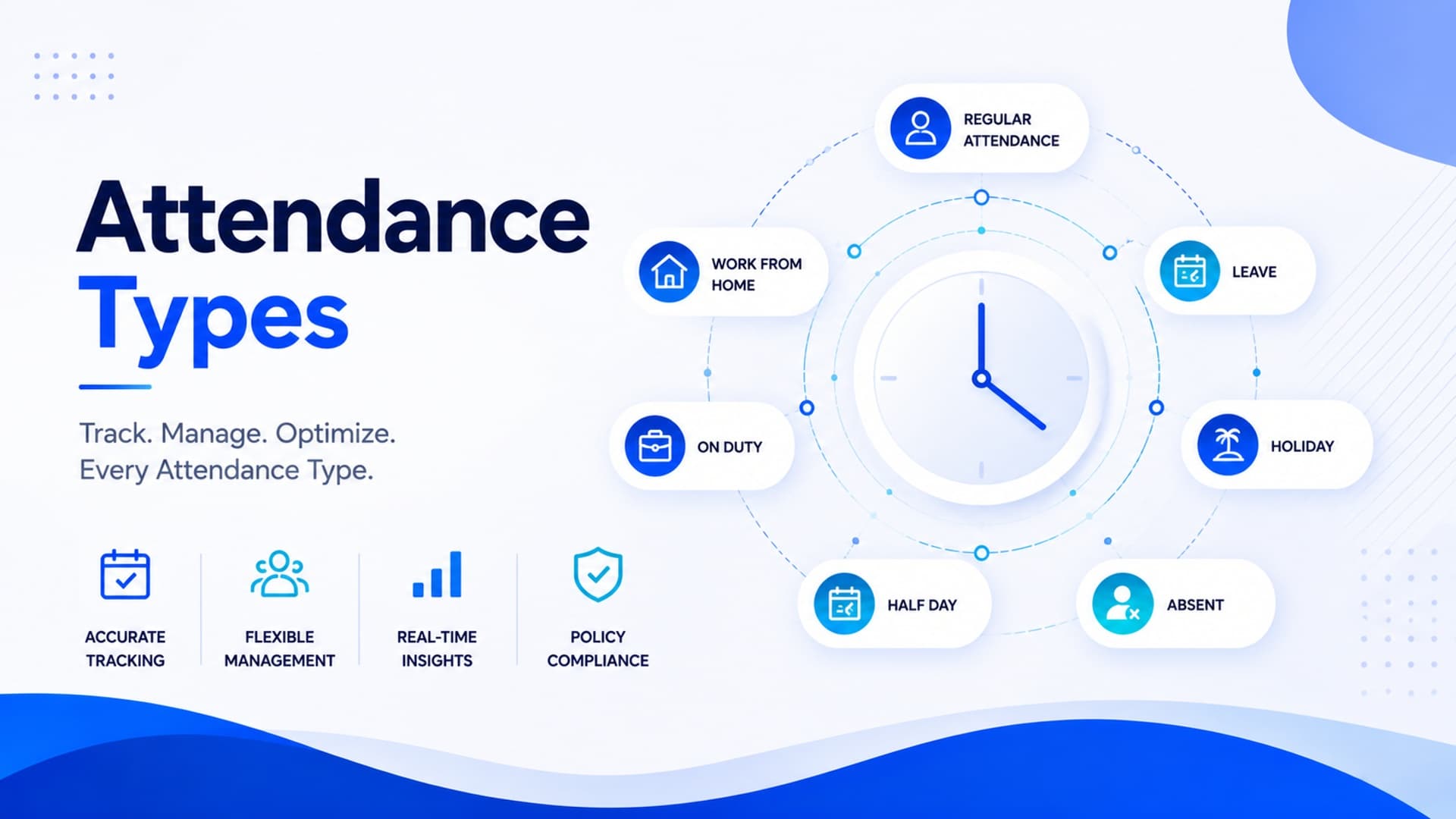
Attendance Types: 7 Powerful Ways to Boost Productivity and Compliance
Attendance Types play an important role in every modern HRM system because businesses today manage different work styles, shift patterns, employee locations, and payroll rules. A single attendance method is no longer enough for every company. Some employees work from the office, some work remotely, some work on field duty, and some follow rotating shifts. That is why companies need a clear and flexible attendance management process.
With SattvaHR, businesses can manage multiple Attendance Types in one HRM software. It helps HR teams track working hours, reduce manual errors, improve payroll accuracy, manage compliance records, and give better visibility to employees and managers. When attendance data is accurate, payroll becomes smoother, employee productivity improves, and HR teams save valuable time.
In this article, we will explain the most useful Attendance Types, their business benefits, and how SattvaHR helps companies manage attendance in a smarter way.
What Are Attendance Types?
Attendance Types are different methods or categories used to record employee attendance. These types help HR teams understand how, when, and from where an employee has marked attendance. For example, an employee may mark attendance through office biometric, mobile GPS, web login, remote work approval, or manual HR entry.
In a traditional office setup, attendance was mostly recorded through a register or biometric machine. But today, business operations are more flexible. Companies have field employees, hybrid teams, remote workers, branch staff, contract employees, and shift-based workers. Because of this, HR teams need a system that can support multiple Attendance Types without confusion.
Why Attendance Types Matter in HRM
Proper attendance classification helps businesses maintain clear employee records. It also supports salary calculation, leave management, overtime tracking, late mark rules, early checkout records, and monthly payroll processing. If attendance is not managed correctly, payroll errors and employee disputes can increase.
SattvaHR helps companies define and manage different Attendance Types based on their internal HR policy. This gives HR teams more control and gives employees a transparent attendance experience.
7 Important Attendance Types for Modern Businesses
1. Regular Office Attendance
Regular office attendance is the most common attendance type. In this method, employees mark their attendance from the office location during fixed working hours. It is useful for companies where employees are expected to work from the office every day.
Benefits of Regular Office Attendance
- Easy to track daily presence
- Useful for fixed office teams
- Supports standard payroll calculation
- Helps monitor late coming and early leaving
- Creates a clear monthly attendance record
With SattvaHR, HR teams can manage office attendance, working hours, late marks, half days, and salary impact from one platform.
2. Mobile GPS Attendance
Mobile GPS attendance is one of the most useful Attendance Types for companies with field employees, sales teams, service staff, delivery teams, and remote site workers. Employees can mark attendance from their mobile app, and the system can capture their location details.
Where Mobile GPS Attendance is Useful
- Sales employees visiting clients
- Field service teams
- Delivery and logistics staff
- Construction site employees
- Remote branch employees
GPS-based attendance improves location transparency. It helps managers verify whether the employee has marked attendance from the correct place. SattvaHR supports mobile attendance features that help businesses reduce fake check-ins and improve field team accountability.
3. Remote Work Attendance
Remote work attendance is useful for companies that allow employees to work from home or any approved remote location. In this attendance type, employees can mark their daily attendance without being physically present in the office.
Remote work has become a practical option for IT companies, digital agencies, support teams, consultants, and service-based businesses. However, HR teams still need proper records for work hours, payroll, and attendance compliance.
Benefits of Remote Work Attendance
- Supports flexible work culture
- Helps remote teams stay accountable
- Improves attendance visibility for managers
- Reduces dependency on manual HR follow-up
- Supports payroll and leave calculation
4. Biometric Attendance
Biometric attendance uses fingerprint, face recognition, or other biometric devices to record employee attendance. It is widely used in factories, offices, hospitals, schools, retail stores, and organizations where physical attendance verification is required.
Biometric attendance can help reduce proxy attendance because the employee must personally verify identity. However, businesses should also use HRM software to sync biometric data with payroll and leave records.
Biometric Attendance Advantages
- Reduces proxy attendance
- Useful for physical workplace teams
- Supports accurate entry and exit timing
- Can connect with payroll workflows
- Helpful for compliance records
SattvaHR can help businesses manage attendance records in a structured way so HR teams do not need to depend only on manual biometric reports.
5. Shift-Based Attendance
Shift-based attendance is important for companies that operate in multiple shifts. This includes manufacturing units, hospitals, security agencies, BPOs, call centers, hotels, restaurants, and logistics companies. In this attendance type, employees are assigned different shift timings based on business requirements.
Common Shift Attendance Examples
- Morning shift
- Evening shift
- Night shift
- Rotational shift
- Flexible shift
- Split shift
Managing shift attendance manually can be difficult. HR teams need to check shift start time, grace period, late marks, overtime, weekly off, and shift change records. SattvaHR helps simplify shift-based Attendance Types so businesses can manage complex work schedules with better accuracy.
6. Manual Attendance
Manual attendance is used when HR or an authorized manager updates attendance records manually. This may be required when an employee forgets to punch in, biometric device data is missing, internet connectivity fails, or special approval is given.
Manual attendance should be controlled properly because it can affect payroll accuracy. A good HRM software should maintain approval records, edit history, and manager-level permissions.
Best Practices for Manual Attendance
- Allow manual entries only with approval
- Maintain reason for every manual update
- Keep edit history for audit purpose
- Limit access to authorized HR users
- Connect manual entries with payroll rules
SattvaHR helps HR teams manage manual attendance corrections in a more organized and transparent way.
7. Overtime Attendance
Overtime attendance is used when employees work beyond their regular working hours. This attendance type is important for payroll calculation, extra pay, compensatory off, and labour compliance records.
In India, working hours, overtime, wages, and related rules are important for employers to manage carefully. Businesses can refer to official government resources such as the Code on Wages, 2019 for wage-related legal context.
Why Overtime Attendance Needs Proper Tracking
- Helps calculate overtime payment
- Supports compliance records
- Prevents payroll disputes
- Gives managers visibility of extra work hours
- Improves workforce planning
How Attendance Types Improve Payroll Accuracy
Attendance data directly affects payroll. If attendance records are wrong, salary calculation can also become wrong. Late marks, half days, absents, overtime, paid leave, unpaid leave, and weekly offs must be calculated correctly before payroll processing.
When companies use multiple Attendance Types in SattvaHR, HR teams can connect attendance data with payroll rules. This helps reduce manual calculation and improves salary accuracy.
Attendance and Payroll Connection
- Present days affect salary calculation
- Absent days may create salary deduction
- Late marks may affect attendance policy
- Overtime can affect additional payment
- Leave records affect paid and unpaid salary days
- Shift records affect work hour calculation
For PF and statutory payroll filing, employers may also need accurate wage and contribution records. EPFO provides an official Online ECR submission facility for registered employers.
How SattvaHR Helps Manage Different Attendance Types
SattvaHR is designed to help businesses manage daily HR operations with better automation. It supports modern attendance workflows so companies can manage office staff, remote employees, field workers, and shift-based teams from one platform.
Key Attendance Management Features in SattvaHR
- Multiple Attendance Types configuration
- Mobile attendance support
- GPS-based attendance tracking
- Shift and working hour management
- Late mark and early checkout tracking
- Leave and attendance integration
- Payroll-ready attendance reports
- Manager approval workflow
- Employee self-service access
Better Control for HR Teams
HR teams can use SattvaHR to reduce manual attendance work. Instead of checking multiple spreadsheets and attendance devices, HR can review attendance records from one system. This saves time and improves monthly payroll preparation.
Better Transparency for Employees
Employees can view their attendance records, leave status, and working days more clearly. This helps reduce repeated HR queries and improves employee trust.
Business Benefits of Attendance Types in SattvaHR
Improved Workforce Productivity
When attendance is tracked properly, managers can understand employee availability, work patterns, late trends, and overtime load. This helps improve planning and productivity.
Reduced Manual HR Work
Manual attendance checking takes a lot of time. SattvaHR helps automate daily attendance records and monthly reports, so HR teams can focus on employee engagement and policy improvement.
Better Compliance Records
Accurate attendance records are useful for payroll audits, labour compliance, internal approvals, and management reporting. With proper Attendance Types, businesses can maintain cleaner data.
Faster Payroll Processing
Attendance and payroll are closely connected. SattvaHR helps payroll teams use verified attendance data for salary processing, overtime calculation, leave deduction, and final payroll review.
Who Should Use Attendance Types in HRM Software?
Every business that manages employees can benefit from attendance management software. But Attendance Types are especially useful for companies with mixed work models, different departments, different shifts, or field teams.
Best Suitable Industries
- IT companies
- Manufacturing units
- Retail businesses
- Hospitals and clinics
- Schools and institutes
- Hotels and restaurants
- Logistics and delivery companies
- Security agencies
- Professional service companies
Explore SattvaHR and Simplify Your HR Operations
To learn more about complete HR automation, visit SattvaHR HRM Software.
For mobile-based employee tracking, read more about Mobile Attendance Apps vs Traditional Attendance.
For workforce planning and team management, explore Workforce Management Software.
To discuss your HRM requirements, visit the SattvaHR Contact Page.
Frequently Asked Questions About Attendance Types
What are Attendance Types?
Attendance Types are different ways of recording employee attendance, such as office attendance, mobile GPS attendance, remote work attendance, biometric attendance, shift attendance, manual attendance, and overtime attendance.
Why are Attendance Types important in HRM software?
Attendance Types help businesses manage different employee work styles. They improve payroll accuracy, attendance transparency, HR reporting, and compliance readiness.
Can SattvaHR manage mobile GPS attendance?
Yes. SattvaHR supports mobile attendance features that can help businesses manage field employees, remote workers, and location-based attendance records.
How do Attendance Types affect payroll?
Attendance Types affect payroll because present days, absent days, leave records, overtime, late marks, and shift hours are used during salary calculation.
Is shift-based attendance useful for manufacturing companies?
Yes. Shift-based attendance is very useful for manufacturing companies because employees may work in morning, evening, night, or rotational shifts.
Can manual attendance be controlled in SattvaHR?
Yes. Manual attendance can be managed with approval control, reason tracking, and HR permissions so attendance correction remains transparent.
Conclusion
Attendance Types are important for every company that wants to manage employees in a professional and accurate way. Different employees may work in different locations, shifts, or work modes. A flexible attendance system helps businesses manage all these situations without confusion.
SattvaHR helps companies manage multiple Attendance Types, including office attendance, mobile GPS attendance, remote work attendance, biometric attendance, shift attendance, manual attendance, and overtime attendance. It improves payroll accuracy, reduces HR workload, supports compliance records, and gives better visibility to employees and managers.
If your business is still managing attendance manually, this is the right time to move to a smarter HRM solution.
Book a Free SattvaHR Demo
Ready to manage Attendance Types with better accuracy and control? Contact SattvaHR today and book your free HRM software demo.